

Water quality touches plumbing in two ways. Some properties, like hardness, affect your pipes, fixtures and water heater. Others affect whether the water is safe to drink, and those are questions for your water utility, your health department and a certified laboratory. This guide explains the plumbing side plainly and describes how testing works in general terms. It is not health or medical advice.
Start by Knowing Your Source
If your water comes from a public water system, the utility is responsible for treating and monitoring it, and it must publish results. If your water comes from a private well, nobody tests it unless you arrange it. The EPA's guidance for private well owners makes this point directly: the owner is responsible for the well's water quality.
Plumbing inside the house can still affect water from a perfectly good public supply. Old galvanized pipe can add rust. Lead can come from older service lines, solder or some fixtures. Water that sits in pipes for a long time, in a vacation home for example, can pick up more from the plumbing than water that moves daily.
Hard Water and Scale
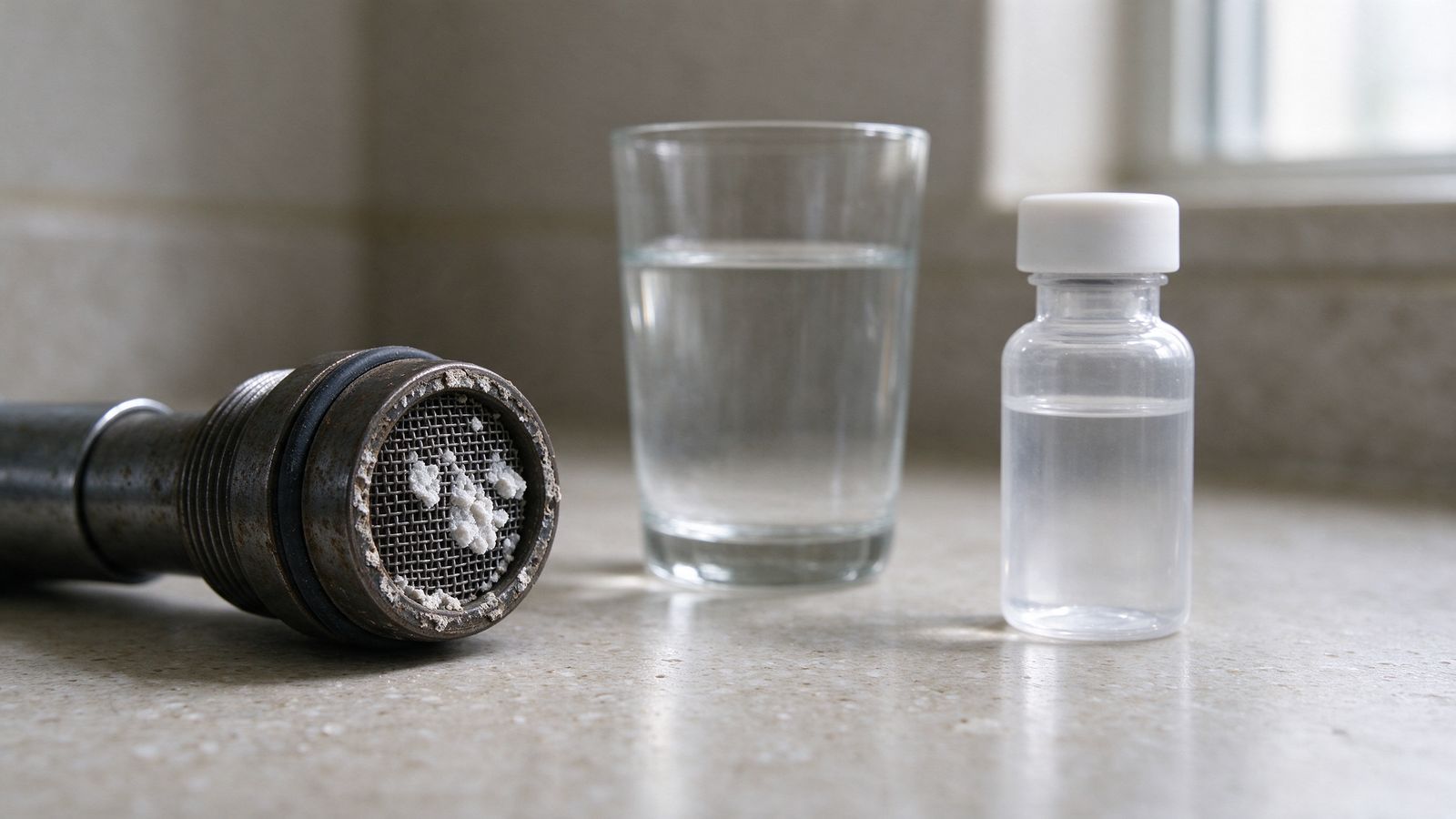
Hardness is mostly dissolved calcium and magnesium. It is not a health concern in the usual sense, but it is a plumbing concern. When hard water is heated or evaporates, those minerals come out of solution as scale, the white crust on showerheads and faucet aerators, the film on glass shower doors, and the sediment that settles in a tank water heater or coats a tankless heat exchanger.
Scale narrows aerators and showerheads, makes heating elements work harder and can shorten the life of appliances that heat water. Signs include spotty dishes, soap that will not lather well and rumbling from the water heater.
How hardness is measured
Labs and utilities usually report hardness as milligrams per liter (mg/L) as calcium carbonate. Water softener makers often use grains per gallon (gpg). One grain per gallon equals about 17.1 mg/L. The U.S. Geological Survey uses these general classes: soft up to 60 mg/L, moderately hard from 61 to 120, hard from 121 to 180, and very hard above 180.
Hardness Converter
Type a number into either box to convert it and see the general USGS class.
Hard (121 to 180 mg/L)
Whether to treat hard water is a judgment call. Softeners, typically ion exchange units, swap calcium and magnesium for sodium or potassium. They need a drain, regular salt, and sometimes have rules about where the discharge can go. Some people soften only the hot water or install a softener with a bypass for drinking water. A licensed plumber or water treatment professional can explain the tradeoffs for your house.
Reading Your Annual Water Quality Report
Community water systems must send customers an annual Consumer Confidence Report, often called a CCR or water quality report, by July 1 each year. It lists where the water comes from, which contaminants were detected, the levels found and how they compare with federal limits. Look for these terms:
- MCL, the maximum contaminant level: the highest level legally allowed in drinking water.
- MCLG, the goal: a level below which there is no known or expected risk to health.
- Action level: for lead and copper, the concentration that triggers additional treatment or other steps by the utility.
If you cannot find your report, search your utility's website or call the number on your water bill. The report covers the public system, not the plumbing inside your house.
How Certified Lab Testing Works
Home test strips are useful for quick checks like hardness or chlorine. For anything health related, the standard is a laboratory certified to test drinking water. States run certification programs, and the EPA keeps contacts for state certification officers, so your state or local health department can point you to certified labs. The general process is described in the steps further down this page.
Public health agencies generally recommend testing a private well at least once a year for total coliform bacteria, nitrates, total dissolved solids and pH, and after flooding, repairs or a change in taste, color or odor. Your health department can tell you which other tests make sense locally.
Treatment equipment ties into the supply plumbing and sometimes the drain system. Installing softeners, filters or whole-house systems, or replacing lead or galvanized lines, belongs with a licensed plumber or qualified water treatment professional.
Water Quality Questions
Does a water filter pitcher fix hard water?
Most pitcher filters are designed for taste, odor and certain contaminants, not hardness. Check a filter's certification to see exactly what it is tested to reduce.
Why does my water look cloudy and then clear up?
Tiny air bubbles are a common cause, especially in cold weather, and they clear from the bottom of the glass up. Cloudiness that does not clear, or any color, deserves a call to your utility or a test.
Should I test for lead?
If your home was built before 1986, has a lead service line or you are unsure, contact your water utility first. Many utilities offer guidance or testing programs, and they can tell you what the service line is made of.