Testing Pressure at a Hose Bib
A basic pressure gauge that threads onto an outdoor faucet or laundry valve is inexpensive at hardware stores and is one of the more useful tools a homeowner can own. Testing is simple and safe:
- Make sure nothing else is using water: no running toilets, irrigation, dishwasher or ice maker cycling.
- Thread the gauge onto the hose bib closest to where the water enters the house, hand tight.
- Open the faucet fully and read the static pressure.
- Check again at a different time of day. Municipal pressure often rises overnight when demand drops.
Some gauges include a second, "lazy" needle that stays at the highest reading. Leave one on overnight and the lazy needle shows the peak, which can be well above your daytime number. That peak is the pressure your fittings actually have to survive.
Watch for thermal expansion
If the reading climbs after the water heater runs, with no fixtures in use, heated water may be expanding in a closed system. That is the job of a thermal expansion tank. The water heater guide explains why closed systems need one.
How a Pressure Reducing Valve Works
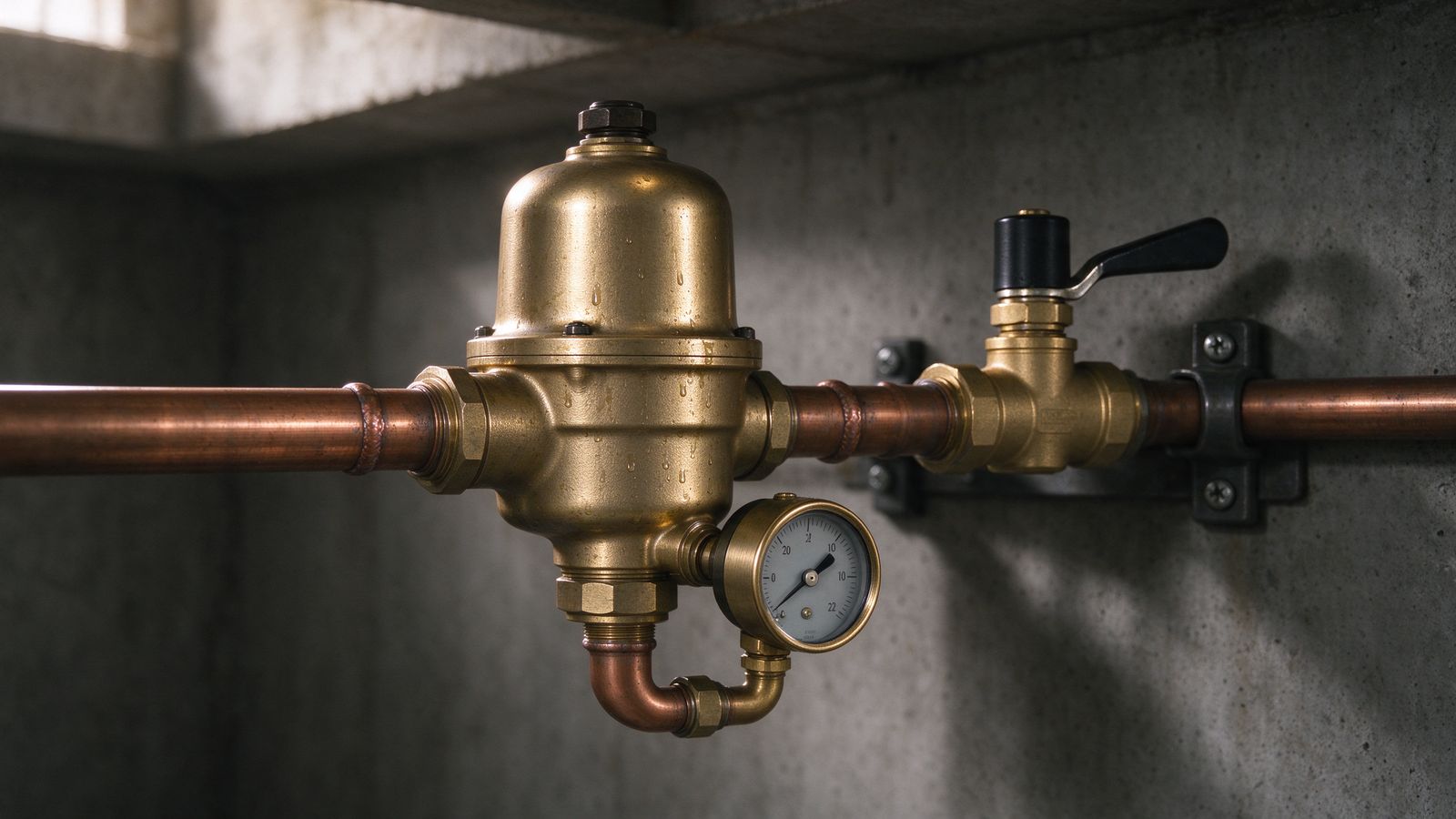
A pressure reducing valve, or PRV, sits on the main line just after the main shutoff. Most are bell shaped and made of brass. Inside, a spring pushes against a diaphragm that is connected to a valve seat. When downstream pressure drops because someone opens a faucet, the spring opens the valve to let more water through. When pressure on the house side rises to the set point, the diaphragm pushes back and the valve throttles closed. An adjusting screw on top sets the spring tension.
PRVs are wear items. Debris, scale and age can stop them from regulating. The usual signs are pressure that creeps up over time, a relief valve on the water heater that drips, banging pipes or a sudden drop in flow. Testing the pressure is a reasonable homeowner task. Adjusting or replacing a PRV is plumbing work, because it involves the main line, code limits and sometimes a permit.
Water hammer
That bang when a valve snaps shut is water hammer: a moving column of water stopping suddenly and sending a pressure spike back through the pipe. Quick-closing valves in washing machines and dishwashers are frequent triggers. High static pressure makes it worse. Plumbers address it with pressure correction, pipe support and water hammer arrestors.
When Pressure Is Low
only one faucet or shower is weak
Clean the aerator or showerhead screen first. Scale and debris collect there. Check that the fixture's stop valve is fully open.
the whole house dropped suddenly
Check that the main shutoff is fully open, ask neighbors about a utility issue, and suspect the PRV. Call a plumber if it persists.
pressure has faded slowly over years in an older house
Corroded galvanized supply pipe is a likely cause. See the pipe materials guide.
only the hot side is weak
Look at the water heater: a partly closed valve, sediment or a failed dip tube. That is a plumber's diagnosis.
On a private well
Well pressure comes from a pressure switch and tank with their own settings and failure modes, and pressure can cycle between two values. Service on the pump, switch or tank belongs with a licensed well or plumbing professional.
Water Pressure Questions
Is higher pressure always better?
No. Above the range fixtures are designed for, high pressure shortens the life of supply hoses, toilet fill valves, faucet cartridges and appliance valves, and it wastes water through every open tap. Steady pressure in the normal band is the goal.
Does every house have a PRV?
No. A PRV is needed where the supply pressure from the street exceeds the limit your local code sets. Homes on low-pressure mains or private wells often have none.
Will a low-flow showerhead fix low pressure?
Low-flow heads are designed to feel stronger at a lower flow rate, so some people prefer them. They do not raise the pressure in your pipes, and if the cause is a clogged pipe or failing valve, the showerhead will not fix it.