

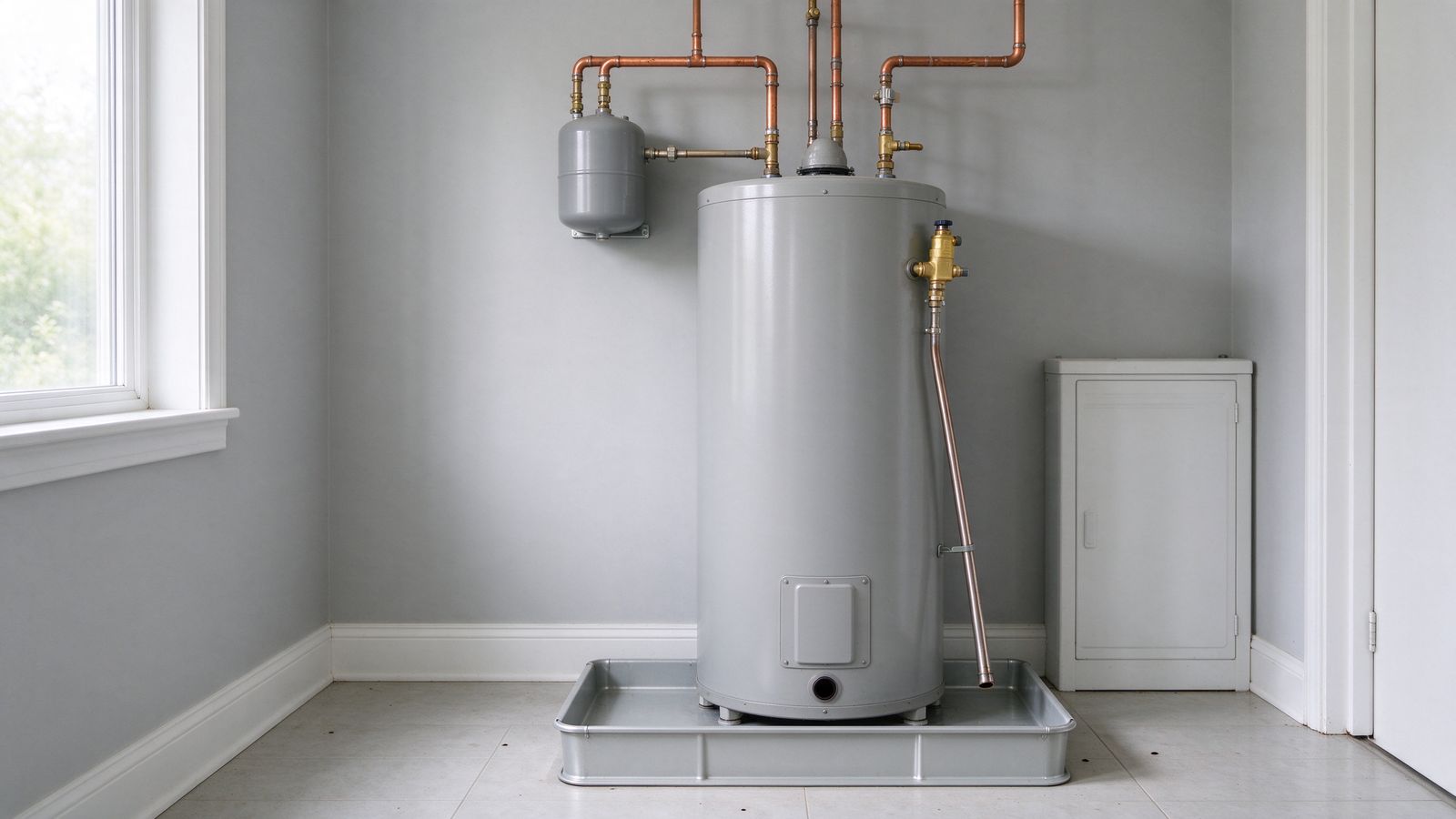
A water heater takes cold water from the supply side, heats it and sends it out on a separate hot line to the rest of the house. That much is common to every type. The differences lie in where the heat comes from, whether hot water is stored or made on demand, and which safety devices protect the house from pressure and temperature.
How a Tank Water Heater Works
A conventional tank heater is an insulated steel tank lined with glass-like enamel. Cold water enters through a dip tube that carries it to the bottom of the tank, where the heat source is. Hot water rises and leaves from the top. A thermostat turns the heat on when the temperature drops below its setting.
Gas models have a burner under the tank and a flue running up through the middle, which carries combustion gases out through a vent. Electric models have one or two heating elements that reach into the water. Either way, a sacrificial anode rod, typically magnesium or aluminum, hangs inside the tank and corrodes in place of the steel. When the anode is used up, the tank itself begins to corrode.
Sediment from the water settles at the bottom over time. In hard-water areas it builds faster, and a heater with heavy sediment may rumble or pop as water trapped under the layer boils. Manufacturers typically describe periodic flushing in the owner's manual.
The U.S. Department of Energy suggests 120°F as a setting that saves energy for most households. Higher settings raise scald risk, especially for young children and older adults. Some households have reasons for a different setting; check the manufacturer's guidance and consider an anti-scald mixing valve if you are unsure.
Tank, Tankless and Heat Pump Compared
Pick a type below to see how it works and what owners tend to notice. Use this to understand a plumber's recommendation, not to choose a model; sizing depends on the household, the fuel available and local code.
Storage tank heater
Keeps a tank of water hot and ready, using gas or electricity. Hot water is available instantly up to the tank's capacity, then has to recover. Simple and familiar, but it loses some heat continuously while it waits.
- Watch for: running out during back-to-back showers, sediment, a corroded anode.
- Needs: floor space, a drain pan where a leak could cause damage, proper venting for gas units.
Tankless (on-demand) heater
Heats water only as it flows through a heat exchanger, so it never runs out, but it can only heat so many gallons per minute. Running several showers at once can exceed what one unit delivers.
- Watch for: scale in the heat exchanger in hard water, a short delay before hot water arrives, minimum flow rates.
- Needs: enough gas supply or electrical capacity, specific venting for gas models, periodic descaling per the manufacturer.
Heat pump water heater
Uses a small heat pump to move heat from the surrounding air into a storage tank, with electric elements as backup. It can use much less electricity than a standard electric tank, and it cools and dries the room it sits in.
- Watch for: slower recovery in heat pump mode, fan noise, a condensate line that must drain properly.
- Needs: enough surrounding air volume and space, a location within the temperature range the manufacturer specifies.
The Safety Parts That Matter Most
Temperature and pressure relief valve
The T&P valve, near the top of the tank, opens if the temperature or pressure inside rises past a safe limit. A discharge pipe runs from it down toward the floor or to an approved drain so that any release is directed safely. That pipe should never be capped, reduced or plugged. A valve that drips or discharges is telling you something, often about high pressure or a failed thermostat, and deserves a plumber's attention.
Thermal expansion tank
Water expands when it heats. In an open system, that small extra volume pushes back into the city main. When a PRV, check valve or backflow preventer closes the system, the extra volume has nowhere to go and pressure rises. A thermal expansion tank, the small tank often mounted on the cold line near the heater, gives that water room. Many jurisdictions require one in closed systems.
Venting, gas and seismic straps
Gas water heaters must vent combustion gases outside and have enough combustion air. Some states and localities also require seismic straps that hold the tank to the wall. Venting, gas connections and installation are licensed work and usually require a permit.
Signs Worth Noting
water pools around the base or the tank itself is wet
Turn off the heater's fuel or power as the manual directs, close the cold inlet valve if you can reach it safely, and call a plumber.
the hot water smells like rotten eggs
A reaction between the anode and certain water can cause it. A plumber can discuss anode options and water treatment.
the relief valve drips
Check your static pressure and whether an expansion tank exists. Have a plumber evaluate; never cap the discharge.
you smell gas near a gas heater
Leave the house and call your gas utility or 911 from outside.
What a Homeowner Can Reasonably Do
Read the label and the manual: it lists the model, capacity and the maintenance the manufacturer expects. Keep the area around the heater clear, especially around gas burners. Look at the discharge pipe and drain pan when you change furnace filters. Some manuals describe testing the T&P valve or flushing sediment; if yours does and you are comfortable following it exactly, those are owner tasks. Anything involving gas, venting, wiring, replacing parts or installing a new unit belongs with a licensed plumber. Tie the heater into your seasonal maintenance checklist so it gets looked at regularly.
Water Heater Questions
How long does a water heater last?
It varies with type, water quality, installation and maintenance. Tank heaters are often described as lasting around a decade, sometimes more, while tankless units can last longer with descaling. The manufacture date on the label tells you how old yours is.
Why does my hot water run out faster than it used to?
Sediment taking up tank space, a failed heating element on an electric model, a broken dip tube mixing cold water into the hot outlet, or a thermostat issue are common causes. A plumber can narrow it down.
Is a tankless heater always more efficient?
Tankless units avoid standby heat loss, but real savings depend on how the household uses hot water, the fuel, the installation and the unit chosen. A heat pump water heater can be very efficient too. Ask a plumber to compare options for your house.